Get In touch
We will respond as soon as possible. Required fields are marked *
Visit Us
Centro Empresarial Sintra-Estoril VI-Fracção P | Impasse Fernão Lopes, 11 - Capa Rota | 2710-264 Sintra | Portugal

The judicious choice of reinforcement orientation and distribution enables differentiated responses to specific efforts both in glassfibre and blanket composites.

Blanket Cross-Section and Surface Texture give an initial assessment of its response consistency.
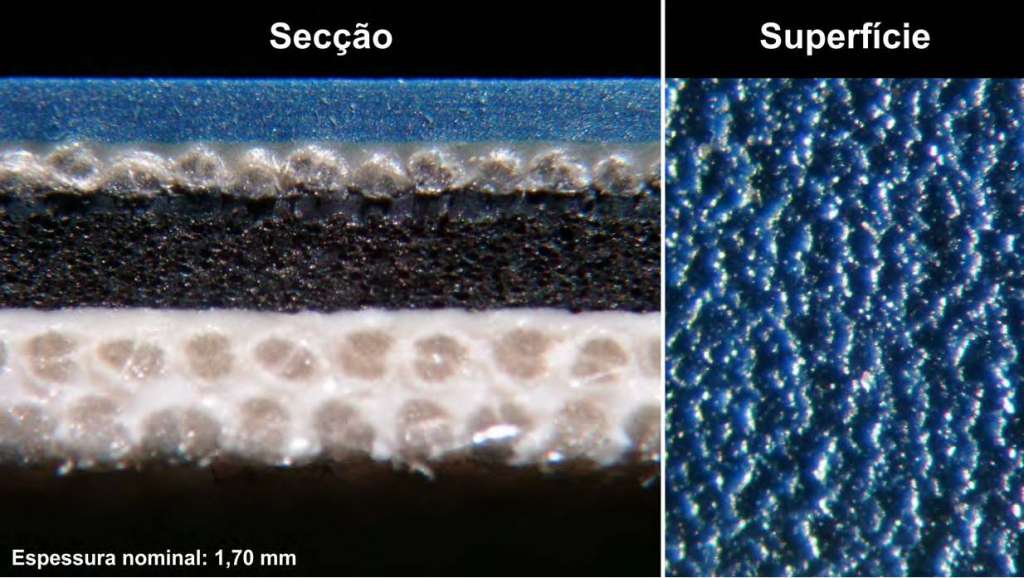
Series 710/1,70 mm Blanket Cross-Section Structure and Surface Texture.
Please note the rectified free surface of the Compressible Layer’s Sub-Assembly.
Personalisation – Custom executions – Each customer has its particular needs.

Base Execution defines best Raw Material origin and the Cutting Method.
It does also include Product Identification and Blanket dressing Procedure, format Corner Trimming and correct Bar details.
Personalisation affects up to 14 Conversion Operations adding another 18 new Parameters and 8 Custom Instructions to meet particular requirements.
Glue Activation Control-Panel has a generous number of different glue activation cycles capability.
Bar geometry and end use conditions set heat cycle temperature and time.
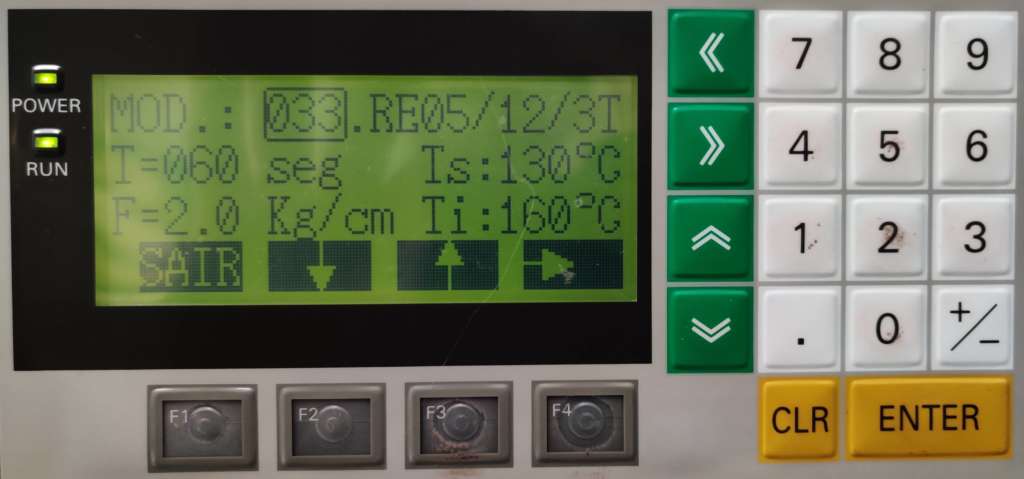
Glue-Activation-Press Control Panel enables the use of the best heat cycle and duration.
It does also register total and still missing number of activation cycles for Quality Assurance purposes.
Bar Press Control Panel has up to 100 different press cycles capacity.
Each register enables to program a wide range of press parameters, to meet specific Bar requirements.
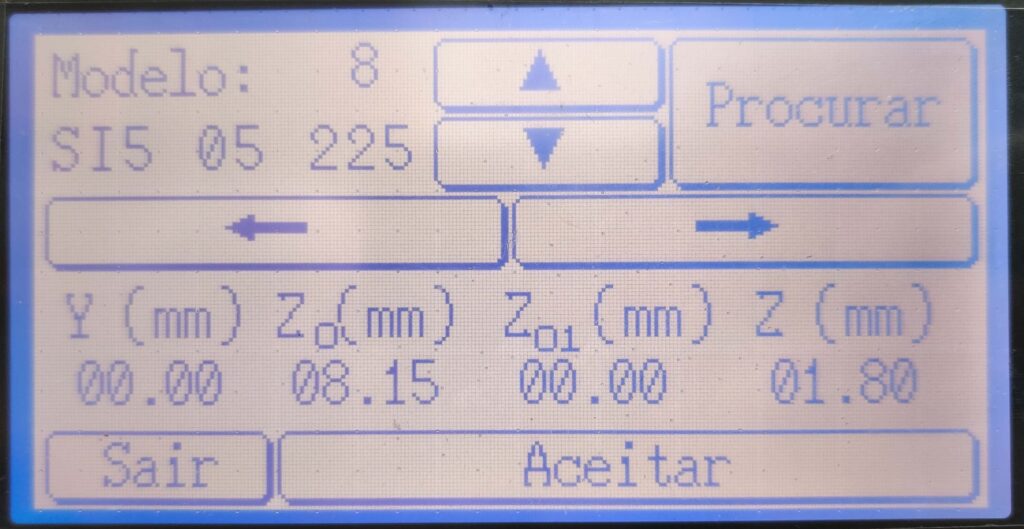
Steel Bar Model description includes sheet gauge and nominal closing thickness.
The image refers to a 0,5 x 12 x 12 mm stainless steel bar designed to close with 2,25 mm.
Tape application CPanel enables control and optimisation on glue tape fitting operation.
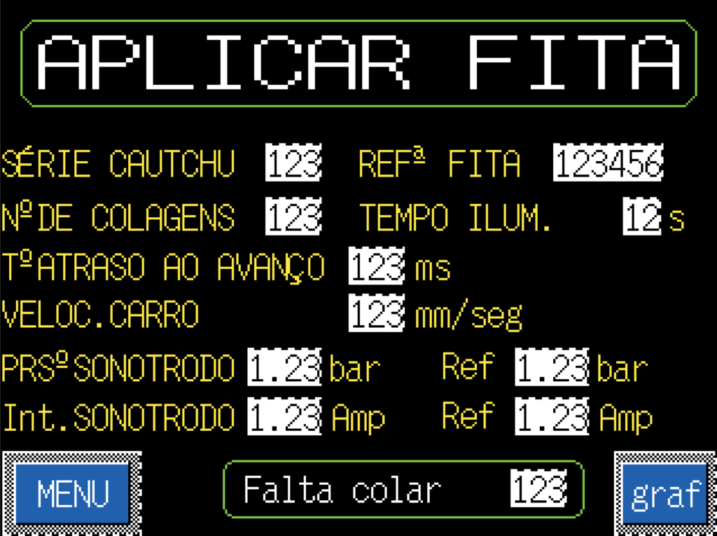
Control Panel enables prompt management of 11 glue operation parameters, of which we highlight:
Blank and Glue Tape Models, Energy transferred and Pressure applied and gluing speed.
Other variables are digitally programmable directly on the data base.
Blankets Package – Narrow-Gap-Web – provides additional moisture protection. It does also reduce handling to the bare minimum until cylinder dressing.
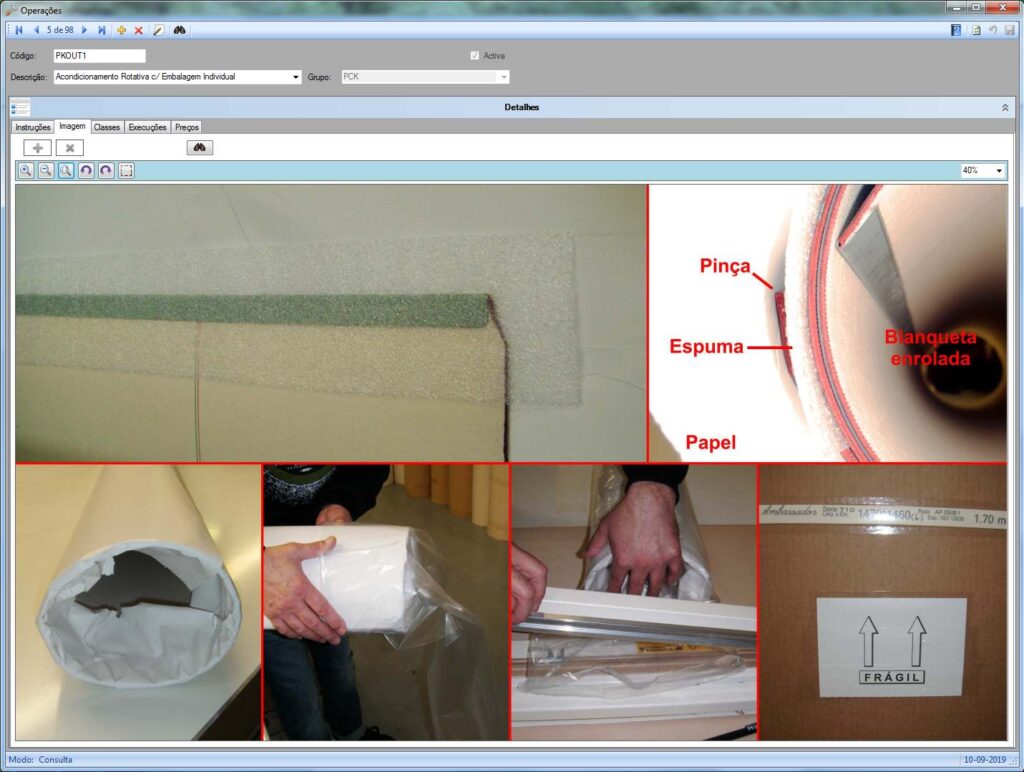
According to PCKOUT instruction, surface rubber faces outwards with bar edges protected by foam tape.
A plastic sleeve, duly sealed at both ends, covers each format.
Hard cardboard boxes protect each set of 4 formats, individually protected by internal cardboard separators.
Web Blankets Package: Follows strict procedures for ease of press cylinder dressing.
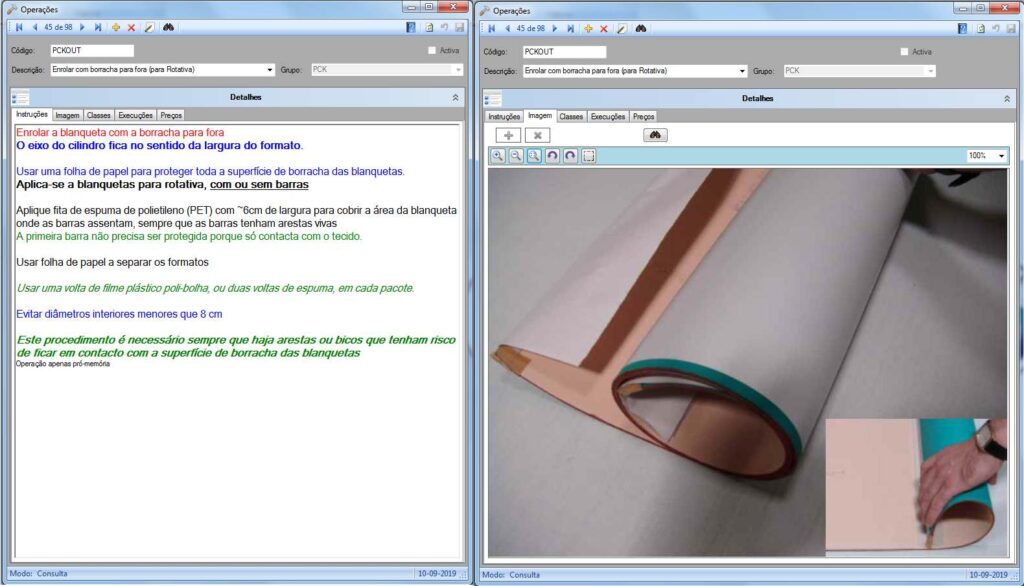
For WEB applications rubber surface faces outwards, duly protected by paper.
Whenever the bars have sharp edges, these must be protected by plastic foam tape.
Blanket Cutting Control Panel coordinates the seamless performance of four independent axes and an enlarged parameter set for confined blanket material cutting.
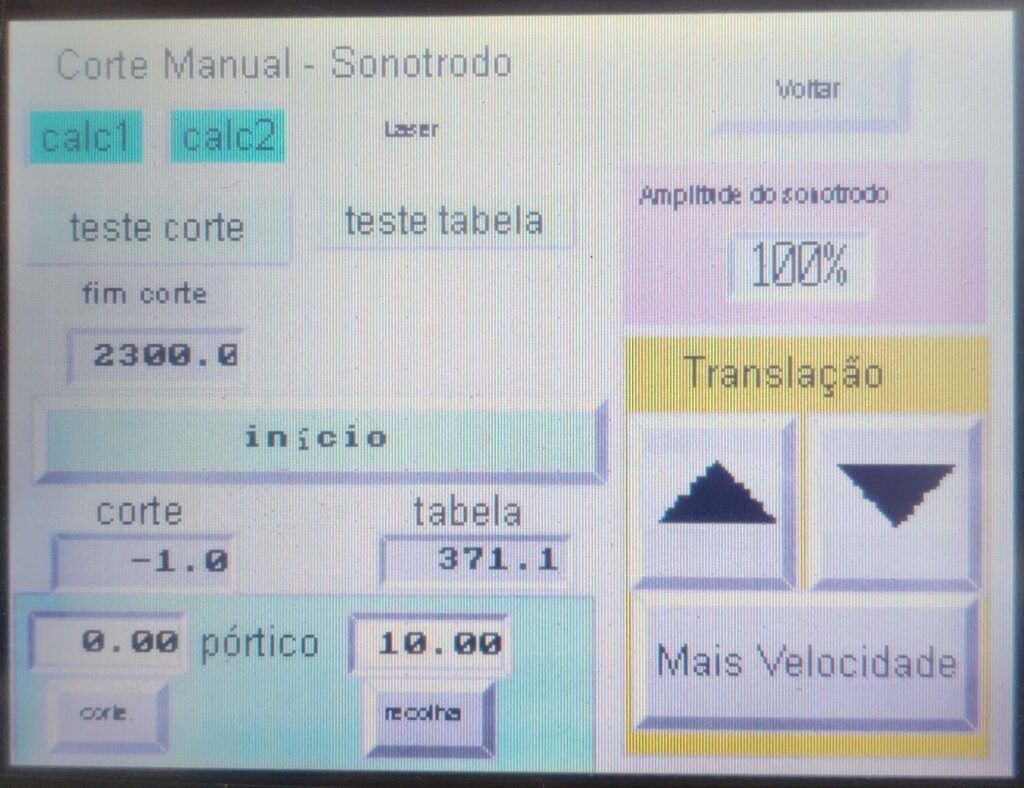
TwoPicture shows Cutting Table Control Panel in its Manual Mode Menu.
Semi-automatic mode has an up-to 8 stage sequential cutting capability from customer’s built-in Data Base.
Semiautomatic Cutting Table assisted by Ultrasound equipment.
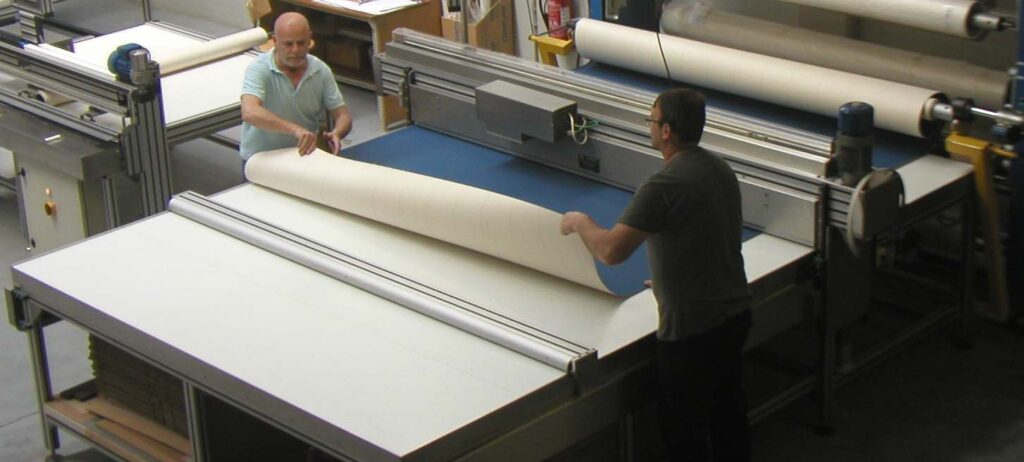
Two Independent Processors digitally control Cutting Head Travel and the respective Depth.
Laser precision equipment warrants Parallelism from the movable stop to the cutting track.
They are just Cause and Consequence, inherent to blanket’s carcass fabrics concept behind its production.

Distortions in the Around and Across directions will necessarily be different.
It is possible to minimize internal tension effects, generated by the warp thread length equalization operation taking place during cloth manufacture stage.
Inline Thickness Control contributes to a new standard of Printing Blankets Conversion.

Dead-weight Thickness Measurement Equipment is an integral part of the blanket format Identification Station, for in-line thickness tolerance checking.
Constructive – Destructive Interference: The resultant of two oscillatory movements is the vectorial addition of the two oscillations.
Let us assume graph 1 is the Applied Oscillation and graph 2 is the Reaction Oscillation. Graph 3 is the resultant.

The above figures – left and right – show two extreme cases when the oscillations are in step (phase) or in counter-phase.
The phase angle between Applied and Reaction Oscillations results from the Response Delay Time and Response Frequency.
In fig.1 the Resultant Amplitude is larger than the Applied Oscillation, while in Fig.2 it opposes the Applied Oscillation.
If Applied and Reaction Oscillation Frequencies are different Resultant Curve is distorted (no longer sinusoidal).
Abrupt Frontier – Depending on the particular instance, Blanket Format edges represent solid/gas, or solid/liquid frontiers.
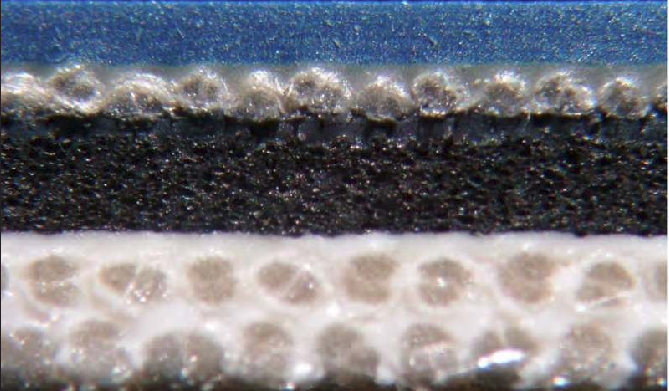
Ambient Moisture during Blanket storage and use, Ink and blanket Washes subject blanket surfaces and edges to degradation.
Spring versus Dashpot: So apparently similar Balls with so completely different reactions.
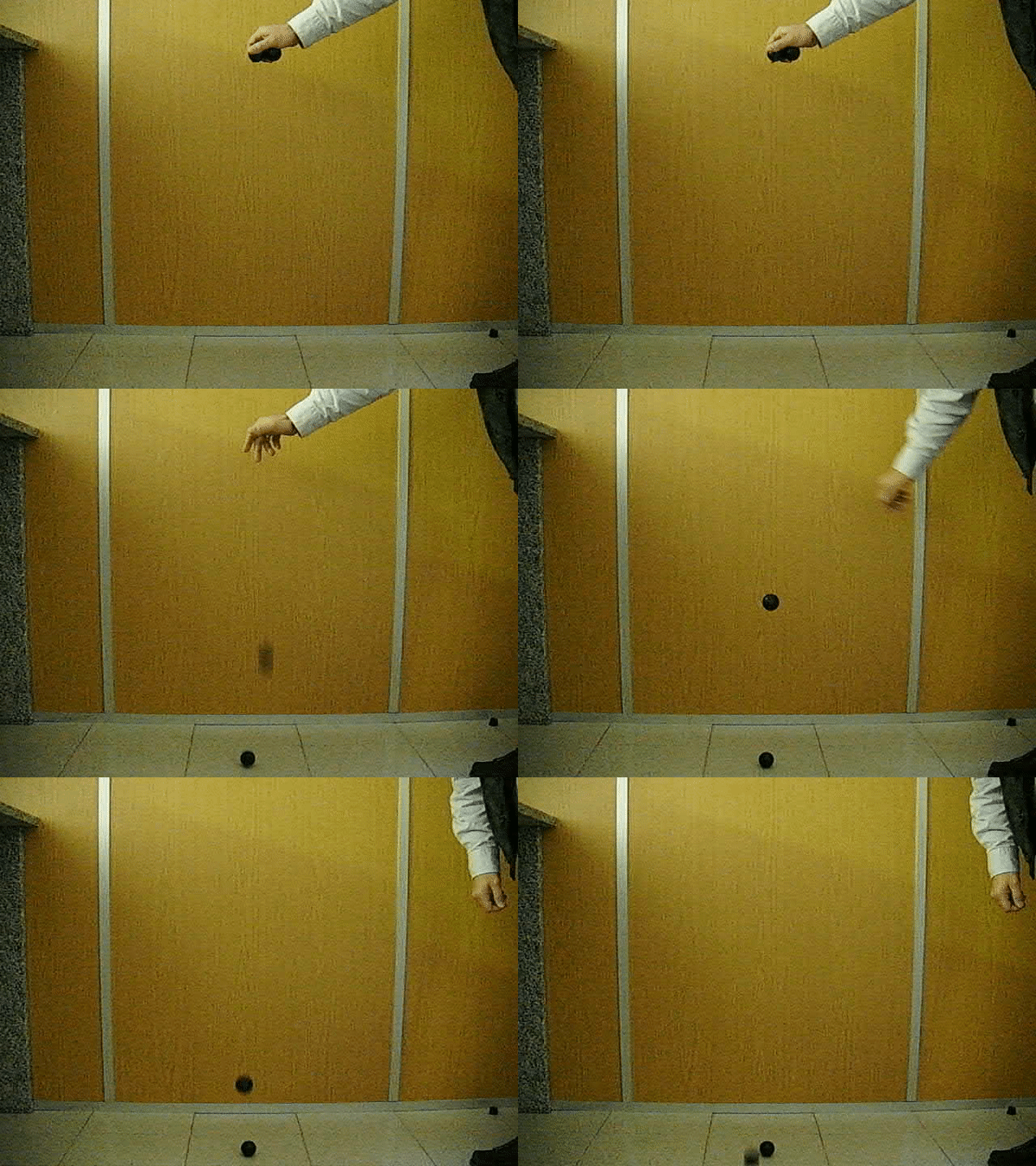
The Happy Ball jumps several times, as it would be normally expected from elastic rubber.
The Unhappy Ball reaches the floor with an even slightly higher Kinetic Energy.
Even so, it does not gather enough free Potential Energy to jump and initiate an oscillatory movement.
Densified Wooden Laminate obtained following compression, with a heating/cooling cycle.
Monitoring veneer moisture is crucial during the complete production cycle.

Magnified view of unidirectional goiabão laminate, 37-layer sample with 2 cm thickness.
Laminate developed for shuttle driving arms of textile weaving looms.
Stator DMC Insulation Caps – Dough Moulding Compound Technology applied into a hot press mould.
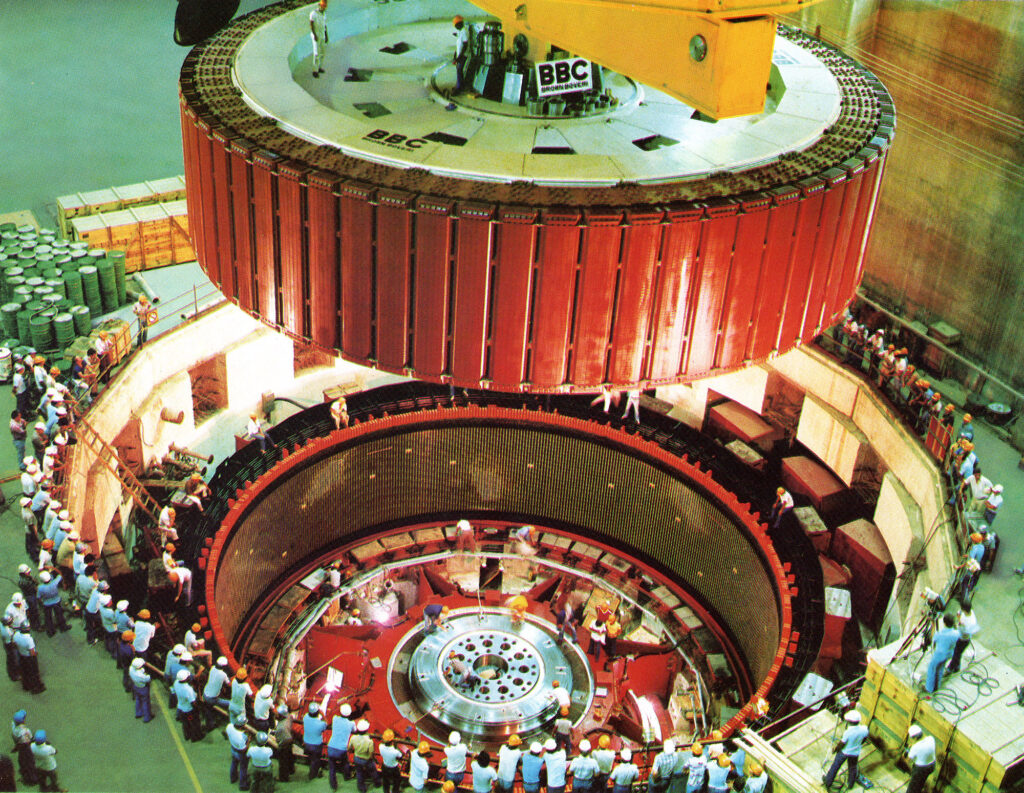
DMC (Dough Moulding Compound) – Insulation caps form a clearly visible orange circle on generator’s stator.
They represent just a small portion of the ~10 Tons insulating laminates supplied to every BBC and Siemens generator.
Hand Tool Insulation Tubes incorporated in mass produced Electric Power Tools.

Constant quality filament wound double insulation tubes used in Black & Decker Hand Tools for added operator protection.
Local Owens Corning factory used this feature to optimise the silane grade for epoxy resins added during Fibreglass extrusion.
Effective Silane use transfers the mechanical stresses applied to the laminate bulk to its fibreglass reinforcement.